
Ice cream - it's basically the universal language of joy, right? From ancient emperors sending runners up mountains for snow to your kid cranking a churn on the back porch, this frozen dessert has a backstory as rich as a French custard base. Pull up a cone. We're going time-traveling.
Jump to:
- The Cool Beginnings: Ice Cream's Ancient Origins
- European Ice Cream Renaissance
- Ice Cream Comes to the New World
- Ice Cream Becomes a Treat for Everyone
- Sundaes, Cones, and Soda Fountains
- Modern-Day Scoops: Ice Cream in the U.S. Today
- Fun Facts to Scoop Up
- Why We All Scream for Ice Cream
- Related Reading
- FAQ: Ice Cream Insights
- 💬 Comments
The Cool Beginnings: Ice Cream's Ancient Origins
Long before freezers, ice cream shops, or soda fountains, people were chasing ways to cool off with something sweet. Around 200 BCE in ancient China, royalty enjoyed a mix of milk, rice, and snow - a chilly ancestor of what we'd recognize today. In ancient Persia, people savored water ices sweetened with fruit and honey. The Romans took it further: Emperor Nero, never one for subtlety, had runners haul snow down from the mountains so his chefs could fold it with honey, fruit, and nuts.
Here's the thing nobody tells you about that "first gelato" - without sugar's structure or a real churn, what Nero's kitchen produced was closer to sweet, icy slush than the silky stuff we scoop now. Still. Snow carried down a mountain by hand, for dessert? That's commitment. Meanwhile in the Middle East, the elite were enjoying faloodeh, a rosewater-and-vermicelli treat that's still served in Iran today.
European Ice Cream Renaissance
By the 13th century, Marco Polo was back in Italy with stories of frozen desserts from his travels. Italy ran with it - gelato became an art form, later refined in Renaissance kitchens. When Catherine de' Medici married Henry II of France in the 16th century, she brought her taste for cold desserts with her and introduced them to French royalty.

Across the Channel, English cookbook authors like Hannah Glasse began printing early ice cream recipes, and the treat spread through Europe's upper class - one handwritten recipe at a time.
Ice Cream Comes to the New World
Ice cream didn't stay a European secret for long. By the 17th century it had crossed to North America with the colonists. George Washington was so fond of it that he reportedly spent around $200 on ice cream in a single summer - a genuinely absurd sum for the 1700s. Thomas Jefferson served it at the President's House, and Martha Washington kept it on the table at Mount Vernon.
Dolley Madison helped cement its status when she served it at her husband's 1809 inaugural ball. And yes - oyster ice cream was briefly a thing. We've collectively, correctly, moved on.
Ice Cream Becomes a Treat for Everyone
For a long stretch, ice cream stayed a luxury, because keeping anything frozen meant expensive ice houses. Then the late 19th century changed everything:
- In 1843, Nancy Johnson patented the hand-crank ice cream churn. This is the real hero of the story - it's the moment ice cream stopped being a rich-person flex and became something a family could make on a Sunday afternoon. The trucks, the sundaes, your KitchenAid attachment? All of it traces back here.
- Jacob Fussell, a Baltimore milk dealer, opened the first large-scale ice cream factory in the U.S., turning a delicacy into something you could just… buy.
- Steam and then electric power let ice cream be mass-produced and properly stored.
- And the ice cream truck rolled in - the original sound of summer.
Sundaes, Cones, and Soda Fountains
The origin of the sundae is gloriously petty. One popular story: vendors invented it to dodge laws banning soda sales on Sundays, serving ice cream with syrup instead. Loophole, meet dessert.
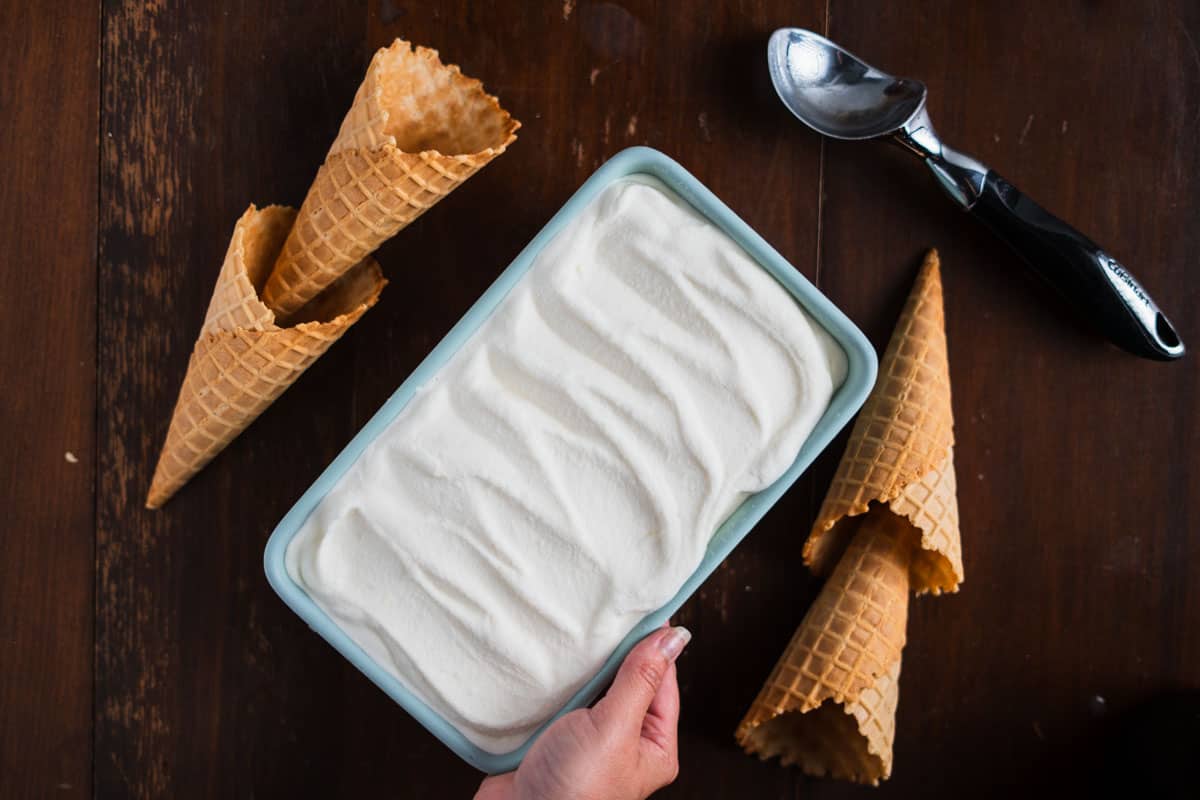
At the 1904 St. Louis World's Fair, an ice cream vendor ran out of dishes - and a nearby waffle seller rolled his waffles into cones to help out. The waffle cone was born from a supply shortage and pure improvisation, which honestly is how a lot of great food happens. Around the same era, Augustus Jackson, a Philadelphia confectioner, developed better ice-cream-making and storage techniques that improved texture and consistency for everyone who came after.
Modern-Day Scoops: Ice Cream in the U.S. Today
Today ice cream fills grocery freezers and small-batch scoop shops alike. One of the best modern origin stories belongs to Ben & Jerry's: in 1978, childhood friends Ben Cohen and Jerry Greenfield took a $5 ice-cream-making course and opened up in a converted Vermont gas station. Quirky flavors, big personality - and a global brand was born.
And we made it official. In 1984, President Reagan declared July National Ice Cream Month, because of course a country that spends this much on dessert needed a holiday for it.
Fun Facts to Scoop Up
- Lick count: It takes roughly 50 licks to finish a single scoop.
- First in print: The earliest known U.S. mention of "ice cream" shows up in 1744.
- Wartime morale: During WWII, ice cream was such a morale booster that the U.S. Navy commissioned a floating ice cream barge for sailors in the Pacific. Not a typo. A barge.
- Brain freeze: That sharp headache is your body's hard stop. Slow down. Enjoy the ride.
Why We All Scream for Ice Cream
Beyond the flavors, ice cream runs on nostalgia. It's childhood summers, the celebratory scoop after a big win, the spoonful that fixes a hard day.

Mine comes with a cautionary tale. I was a kid in my favorite white dress - and a scoop of chocolate ice cream that did exactly what chocolate ice cream does on white cotton. One drip, one stain, one small heartbreak. I've never liked chocolate ice cream since. I can walk you through a proper custard base in my sleep, but hand me a chocolate cone and I'll still pass. Some food memories don't care how much training you have.
So next time you grab a scoop, remember - you're part of a tradition that stretches from snow hauled off Roman mountains to the truck rolling down your street. Just, you know. Maybe not in white.
Related Reading
Now that you know the history, take your ice cream knowledge further:
- Explore the complete Types of Ice Cream guide - from American style to kulfi.
- Compare the Italian classic in Gelato vs Ice Cream: 6 Key Differences.
- Try our most popular recipe: KitchenAid Ice Cream.
- For a Mexican twist: Easy Mexican Vanilla Ice Cream.
FAQ: Ice Cream Insights
Not at all! With today's tools like electric ice cream makers and simple recipes, making ice cream can be as easy or as creative as you want.
Early frozen desserts originated in ancient China and ancient Persia, where people mixed snow with dairy or fruit and honey - the distant ancestors of modern ice cream.
American colonists introduced ice cream to the New World, and figures like George Washington and Thomas Jefferson helped make it popular.
Augustus Jackson, a Philadelphia confectioner, developed improved ice-cream-making and storage techniques in the 19th century, refining texture and consistency.
Cafe Procope in Paris, opened in 1686, is often credited as one of the first cafes to serve ice cream to the public.





Comments
No Comments